

The short answer
Lodge recommends an oil with a high smoke point for seasoning and names vegetable oil, melted shortening and canola oil. Plenty of cooks use flaxseed oil too. For conditioning after washing, a stable oil such as refined coconut oil is a common choice. The chart compares common oils by heat range and best use.
The comparison chart
Smoke point is the temperature where an oil starts to break down and smoke. Exact numbers vary with how an oil is refined and stored, so the chart uses the heat-range groups published by UConn Extension rather than single figures.
We compare oil types, not brands. Our own products appear only as an example of each use.
| Oil | Heat range | Best use | Notes |
|---|---|---|---|
| Flaxseed oil | No heat when eaten (UConn) | Seasoning | Many cooks season with it, and it is what our Cast iron oil is made from. Keep the bottle cold after opening. |
| Refined coconut oil | Medium (UConn) | Conditioning | Wiped on after washing to protect seasoning. It is what our Cast iron conditioner is made from. |
| Canola oil | Medium to high (UConn) | Seasoning, cooking | One of the oils Lodge names for seasoning. |
| Vegetable oil (soybean) | Medium (UConn) | Seasoning, cooking | Another oil Lodge names for seasoning. |
| Grapeseed oil | Medium to high (UConn) | Cooking | A light oil for everyday cooking. |
| Avocado oil | High (UConn) | Cooking | Suits searing and high-heat cooking. |
| Extra virgin olive oil | Medium to high (UConn) | Cooking | A good everyday cooking oil. Cooks differ on using it for seasoning. |
Heat ranges: UConn Extension, heart healthy cooking oils. Seasoning oils named by Lodge.
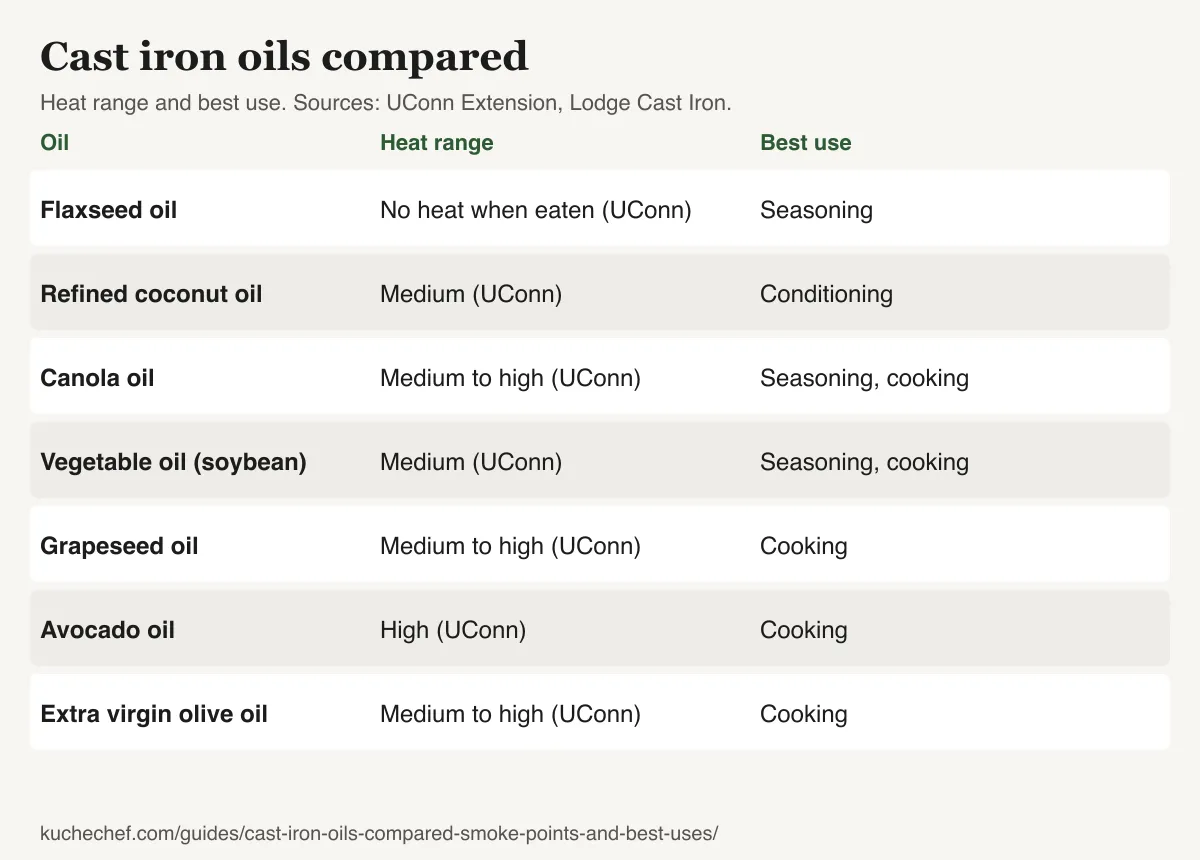
Copy this HTML to share the chart on your own site. It links back to this page.
Seasoning, conditioning and cooking are different jobs
Seasoning is oil baked onto the pan until it hardens into a slick layer. Lodge describes it as oil that changes through polymerization and bonds to the iron. It is done in the oven, in thin coats.
Conditioning is a light wipe of oil after each wash, to protect that layer between cooks. Cooking is simply the oil in your pan at dinner. An oil can be a fine cooking oil and a poor seasoning oil, or the other way round, so it helps to match the oil to the job. Read why refined coconut oil suits cast iron conditioning.
Why advice differs between cooks
Lodge points to oils with a high smoke point for seasoning. Many home cooks swear by flaxseed oil, which UConn lists as a no-heat oil for eating but which is widely used for oven seasoning. Both groups end up with the same thing: thin coats, wiped back, baked on.
Whichever oil you choose, the method matters as much as the bottle. Too much oil gives a sticky finish, so wipe each coat back until the pan looks almost dry. For outdoor cooking, see Cast iron grill oil, the same flaxseed oil in a spray bottle for grill grates.
Common questions
What is the best oil for seasoning cast iron?
There is no single answer. Lodge names vegetable oil, melted shortening and canola oil, and many cooks use flaxseed oil. Thin coats baked on matter most.
What is a smoke point?
It is the point at which an oil begins to break down structurally, and it varies with how the oil is refined.
Is conditioning the same as seasoning?
No. Seasoning is baked on in the oven. Conditioning is a thin wipe of oil after washing to protect the seasoning.
Can I share the chart on my site?
Yes. Copy the embed code under the chart. It includes a credit link back to this page.


